
Dust.tt Review: Stop Playing Hide-and-Seek with Company Knowledge
The Problem: Your company knowledge is playing hard-to-get.
Let me guess.
Your onboarding doc is in Notion. The latest pricing is in a Google Sheet. Crucial product decisions are buried in Slack threads from three months ago. The API docs are in Confluence (maybe). And the one person who "just knows everything” is… on vacation. Again.
So you do what any modern professional does: you start a heroic quest across 15 tabs, summon the ancient artifact known as "Ctrl+F,” and end the day with 7% less sanity and 42% more "I’ll get back to you.”
This is the exact kind of workplace mess the AI platform Dust is built to fix.
Executive Summary: What is Dust?
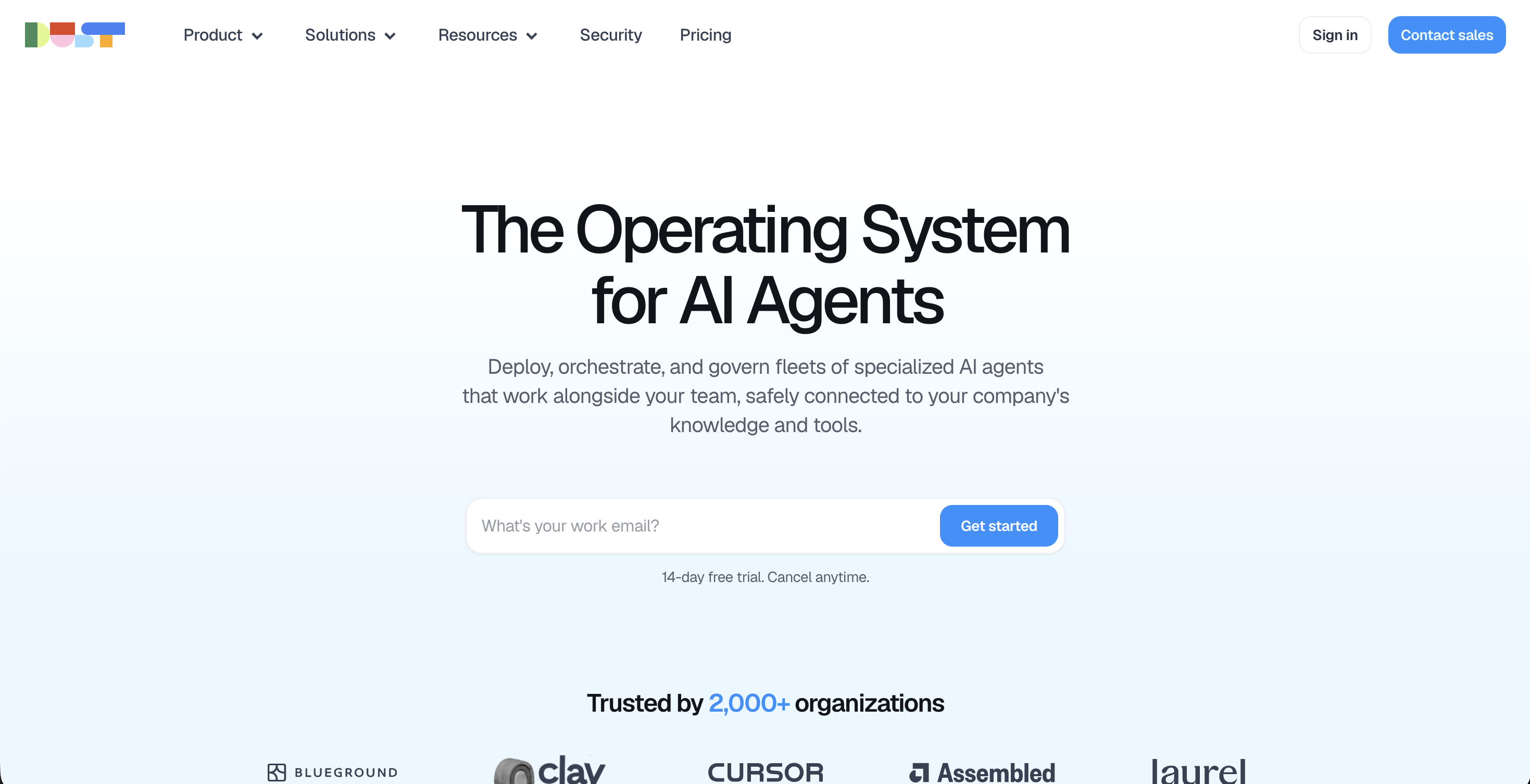
Dust (dust.tt) is an AI platform that connects to your company’s internal tools (Notion, Slack, Drive, etc.) to create custom "agents."
- Ideally for: Teams heavily using Slack, Support, and Ops.
- The Vibe: Hiring a super-intern who reads everything instantly and never sleeps.
- Key Feature: It doesn’t just chat; it performs tasks securely without training models on your data.
Understanding the Dust.tt Platform
Think of Dust as a platform where you can build custom AI colleagues. You connect them to your company’s tools and knowledge, and use them where work actually happens (usually Slack).
Imagine hiring a Super-Intern who:
- Reads faster than humanly possible.
- Never complains about repetitive questions.
- Has access to every folder you give them permission to see.
- Can be trained into a specialist (e.g., Support Agent, Sales Writer, Policy Explainer).
Dust markets itself around connecting your data securely and going "beyond chat” into actual work: search, analysis, web navigation, and multi-step help inside one workspace.
How Dust AI Agents Work
Here is the mental model that makes it click:
1. You give Dust a "Pantry”
You connect your work apps so Dust can reference real company context instead of freestyling like a karaoke singer who’s never heard the song.
- Connectors include: Slack, Google Drive, Notion, Confluence, GitHub, and more.
2. You create "Specialist Employees” (Agents)
Instead of one generic "Chatbot," you make agents with specific jobs:
- Support Sidekick: Answers customer questions using only your help docs.
- Release Notes Writer: Reads GitHub commits and summarizes them for marketing.
- Policy Paladin: Helps teams follow internal HR rules without pinging Legal.
3. The Agents get to work
Dust’s Slack integration allows you to call different agents (e.g., @dust or @support_bot) directly in threads. They don’t just talk; they can search, analyze, and navigate the web.
Note for the Techies: If you have a developer on hand, Dust offers webhooks, an API, and integrations to plug in custom tools.
Case Study: Building a "Support Sidekick”
(The Aha! Moment)
Let’s say you run a B2B SaaS. Tickets are pouring in. The same questions, over and over. Your best support rep answers them with the emotional energy of a printer that just jammed.
So, you build a Dust agent.
The Goal: In Slack, your support team asks: "Hey Dust, how do we handle SSO setup errors for Enterprise customers?"
The Setup:
- Connect: Your help docs (Notion/Confluence) and internal runbooks (Drive).
- Instruction: "You are a support agent. Only answer based on these documents. Be polite."
The Result: The agent finds the relevant internal article, summarizes the fix steps, adds the specific "don't forget this checkbox" footnote that everyone misses, and drafts a customer-ready reply in your brand tone.
The Aha Moment: It’s not AI replacing support. It’s AI turning your support team into cyborgs (the useful kind, not the sci-fi coup kind).
Key Business Use Cases for Dust AI
- Slack-Native Team Assistant Dust leans hard into the idea that agents live inside your conversations. They are thread-aware and can be summoned by name. If your company treats Slack as its Operating System, this is huge.
- Customer Support Acceleration There is a Zendesk integration that brings your custom agents right into ticket handling, providing context instantly.
- Legal & Compliance Self-Serve Instead of waiting 3 days for a privacy review, a "Legal Bot" can scan a request against your internal policy docs and give a preliminary "Safe" or "Flagged" rating.
- Ops Reporting Because agents can search across sources, it’s useful for "What’s the latest on Project X?" questions that usually result in 12 pings and a meeting that could’ve been an email.
Pros and Cons of Dust.tt
What Dust does really well
- Company Grounding: It prioritizes connecting internal tools to prevent "hallucinations."
- Multi-Agent Setup: Your "Sales Writer" shouldn't behave like your "Security QA" bot. Dust separates them beautifully.
- Enterprise Posture: It pushes GDPR compliance, SOC 2 Type II, and HIPAA capabilities.
- "No Training" Promise: Their docs explicitly say they do not train their models on your company data.
Limitations to Consider
- Garbage In, Garbage Out: If your Notion docs are outdated, duplicated, or contradictory, your agent will confidently walk you into the wrong room. Dust can’t fix messy knowledge; it just surfaces it.
- Some Assembly Required: You can do a lot without code, but the power features (custom integrations/webhooks) are easier if you have a technical friend.
- Not a Toy: If you want "make me a fantasy novel," look elsewhere. This is for workflows.
Dust Pricing Structure
- Pro: €29/month per user (approx $32 USD). Includes advanced models (GPT-4, Claude 3, etc.) and major connectors.
- Enterprise: Custom pricing (starts at 100+ users). Adds SSO and multiple workspaces.
- Trial: 14-day free trial available.
Security and Privacy Standards
- Data Security: SOC 2 Type II and GDPR compliant.
- Model Usage: They use providers like OpenAI, Anthropic, and Gemini, but use "Zero Data Retention" policies for model interactions.
- The Big One: They do not train models on your data.
(Disclaimer: Always have your own security team review the terms, especially for regulated industries.)
Final Verdict: Is Dust Worth It?
If your team’s biggest bottleneck is knowledge scattered across tools, Dust is one of those "Why didn’t we do this earlier?" platforms.
The magic isn’t that it’s AI. The magic is that it’s AI aimed at the boring stuff businesses actually do all day: finding files, summarizing threads, and answering questions with receipts.
Best for:
- Teams living in Slack.
- Support-heavy organizations.
- Ops and Internal Enablement teams.
- Companies that want "agents" without hiring an AI engineering department.
Skip if:
- Your internal documentation is a landfill fire (fix the knowledge first!).
- You need a purely creative consumer tool.
- You want heavy custom automation but have zero technical support.
Dust isn’t famous-famous. It’s not a billboard tool. It’s more like that excellent neighborhood restaurant that doesn’t advertise because it’s already busy. And honestly? That’s often where the good stuff is.